Executive summary
In many organizations, the intensity of work is still interpreted as an indicator of productivity. Full schedules, numerous ongoing projects, frequent meetings and constantly busy employees can create the impression of a dynamic, results-oriented company. However, a high volume of activity does not necessarily correspond to proportionate progress towards strategic objectives.
When priorities multiply, responsibilities overlap and functions operate according to different approaches, a significant proportion of organizational energy is absorbed by coordination, managing urgent issues and resolving recurring problems.
The result is an organization that works intensively but struggles to concentrate its resources on the initiatives that are genuinely critical to growth and transformation.
Understanding this dynamic requires moving beyond an interpretation focused exclusively on individual productivity and examining how the organization operates as a whole: from priority setting to decision-making mechanisms, from the distribution of responsibilities to cross-functional collaboration.
Improving Organizational Effectiveness means creating the conditions for people’s work to contribute consistently to shared objectives, reducing wasted effort and strengthening execution capability.
When being constantly busy becomes the norm
In many companies, the feeling of not having enough time has become a normal part of everyday working life. Managers handle numerous activities simultaneously, teams work on parallel projects, and meetings occupy a significant proportion of the working day.
Despite this level of commitment, some strategic initiatives progress slowly, decisions require continuous realignment, and the same issues tend to recur.
Faced with these difficulties, the most immediate response is often to demand greater speed, increase control over activities or ask people to make an additional effort.
However, when an organization is already operating under considerable pressure, increasing the intensity of work may aggravate the problem rather than resolve it.
The fundamental question is not how hard people work, but how effectively the organizational system enables them to direct their efforts towards meaningful results.
A company may employ highly competent and committed professionals yet continue to struggle to achieve its objectives if activities are insufficiently coordinated or priorities change continuously.
Organizational Effectiveness depends not only on people’s ability to perform their individual responsibilities well, but also on the organization’s ability to transform individual and functional contributions into collective results.
This distinction is particularly important during periods of growth, when increasing complexity requires different approaches to coordination and management from those that supported the company’s operations in earlier stages.
The priority problem: when everything is important, nothing really moves forward
One of the most common causes of organizational inefficiency is the difficulty of translating strategy into a manageable number of operational priorities.
Companies may have a clear strategic direction but struggle to translate it into concrete choices about which initiatives to pursue, which activities to scale back and where to concentrate available resources.
When new priorities are added without reviewing existing ones, workloads progressively increase, and people find themselves managing objectives that compete for the same resources.
The problem becomes even more evident when different functions interpret priorities according to their own objectives.
The sales function may focus on revenue growth, operations on process continuity and efficiency, while other business areas pursue equally legitimate objectives that are not always fully compatible in the short term.
Without shared criteria for managing these interdependencies, each function may achieve satisfactory results against its own performance indicators without the organization as a whole progressing in the intended direction.
The result is a multiplication of activities that does not always correspond to an increase in the value generated.
For this reason, setting priorities does not simply mean determining what is important. It also means making decisions about what can be postponed, scaled back or discontinued.
A strategy becomes truly operational when it enables the organization to choose where to concentrate its energy and, above all, where not to waste it.
Inefficiencies that consume energy without creating value
Organizational inefficiency does not arise exclusively from an excessive number of activities. It can also be driven by operating practices that require continuous coordination, verification and realignment.
When responsibilities are insufficiently defined, people spend time clarifying who should handle particular activities or make specific decisions.
When information does not flow effectively between functions, teams may conduct repeated checks, work with different sets of data or address problems that could have been resolved at an earlier stage.
When decision-making processes are excessively centralized, management tends to depend on senior leadership even for operational matters, creating delays and reducing the organization’s ability to respond promptly.
These inefficiencies have a cumulative effect: an increasing proportion of work is devoted to managing difficulties generated by the organization’s own operating practices.
This creates a situation in which people are constantly busy, but a substantial share of their energy is absorbed by coordination, corrective activities and managing urgent issues.
It is important to distinguish these dynamics from necessary coordination. In complex organizations, cross-functional dialogue, information sharing and decision reviews are essential activities.
The problem arises when these activities no longer facilitate work but become necessary to compensate for ambiguous responsibilities, inconsistent processes or priorities that are not shared.
An effective organization is not one that eliminates coordination, but one that ensures coordination is proportionate to the complexity of the decisions and activities being managed.
Why asking people to be more productive is not enough
When results do not progress at the desired pace, attention frequently turns to individual performance.
New monitoring tools are introduced, reporting systems are strengthened, or managers are asked to improve how they manage their time and activities.
These interventions can be useful, but they are insufficient when difficulties arise from organizational conditions that individuals cannot change independently.
A team may improve its productivity but continue to experience delays if it depends on decisions made elsewhere.
A manager may organize their activities effectively but remain overloaded if they receive conflicting requests from different levels of the organization.
A function may achieve its objectives while unintentionally slowing down other business areas when performance measurement systems fail to account for interdependencies.
These examples demonstrate why individual performance and organizational effectiveness should not be confused.
The former concerns people’s contributions in relation to their assigned responsibilities. The latter concerns the system’s ability to integrate those contributions and direct them towards shared results.
Improving overall effectiveness therefore also requires addressing the conditions that shape everyday work: priorities, responsibilities, processes, decision-making mechanisms and collaboration practices.
This does not diminish the importance of leadership and managerial capabilities. On the contrary, it reinforces their role, as managers must develop a broader understanding of interdependencies and take responsibility not only for the results of their own function, but also for their contribution to organizational objectives.
From work intensity to organizational effectiveness
Improving organizational effectiveness first requires understanding where energy is being invested and to what extent activities contribute to strategic priorities.
The starting point is to analyze how the company actually operates, examining not only results but also the processes through which those results are achieved.
It is necessary to understand which activities consume the most resources, where delays occur, which decisions require continuous intervention and which interdependencies generate recurring difficulties.
This analysis should be developed through dialogue between executive leadership, management and operational functions, because organizational challenges are rarely fully visible from a single perspective.
Once the main causes of wasted effort have been identified, attention can turn to several fundamental areas.
- The first concerns strategic priority alignment, ensuring that different functions share a concrete understanding of objectives and the criteria used to allocate resources.
- The second concerns clarity of responsibilities and decision-making mechanisms, reducing overlaps, unnecessary steps and excessive dependence on senior leadership.
- The third concerns cross-functional coordination, through collaboration practices that enable interdependencies to be managed without unnecessarily multiplying meetings and reviews.
- Finally, it is necessary to strengthen execution capability by linking strategic initiatives to clear responsibilities, resources, timelines and measurable outcomes.
Improvement should not be assessed solely through reductions in activities or operational time, but also by examining the organization’s ability to complete priority initiatives, make appropriate decisions and adapt its operating practices as requirements change.
The objective is not simply to work less, but to make better use of available resources, increasing alignment between organizational effort and results.
Quantasia perspective - Unlocking organizational potential through collaborative work
From Quantasia’s perspective, situations in which a company works intensively without achieving proportionate progress require an analysis that goes beyond individual productivity.
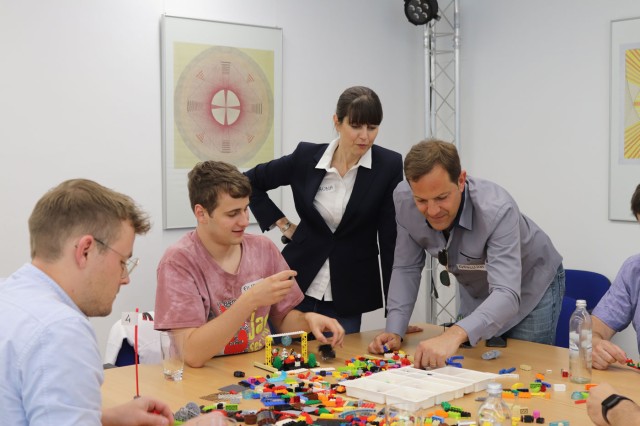
Organizations often already possess the capabilities needed to address many of their challenges. What may be missing is the opportunity to examine how the system operates as a whole, recognize interdependencies and develop solutions that extend beyond the boundaries of individual functions.
For this reason, the consulting process begins with an understanding of organizational dynamics and the direct involvement of the people who experience them in their everyday work.
Engaging with business owners, executive leadership, management and teams makes it possible to integrate different perspectives, identifying not only the most visible inefficiencies but also the conditions that generate and perpetuate them.
Quantasia supports this process through an approach that integrates strategic and organizational analysis, facilitation, co-design and leadership development, with the aim of translating identified challenges into concrete and sustainable changes.
Depending on the organization’s specific needs, this work may involve redefining priorities, evolving the Business Operating Model, improving decision-making mechanisms or strengthening cross-functional collaboration.
The participatory dimension does not replace the rigor of Organizational Design, but helps ensure that it reflects the company’s operational reality more accurately. Involving people means recognizing and leveraging knowledge and experience that would be difficult to capture through formal process analysis alone.
At the same time, dialogue must translate into clear organizational choices, defined responsibilities and verifiable operating practices, ensuring that the solutions identified do not remain shared intentions but become part of everyday organizational functioning.
Organizational Effectiveness develops when strategy, structure, processes and behaviors are aligned, enabling the capabilities already present within the company to contribute fully to results.
The questions every executive should ask
Understanding whether an organization is using its resources effectively requires examining not only the volume of activities, but also their alignment with strategic objectives.
Executive checklist
- Have strategic priorities been translated into clear operational choices shared across different functions?
- Do we know which activities consume the most resources and how much they contribute to expected results?
- When new initiatives are introduced, are existing priorities and committed resources also reviewed?
- Do responsibilities and decision-making mechanisms support autonomy and execution, or do they create delays and overlaps?
- Does management have structured opportunities to address cross-functional challenges and identify shared solutions?
- Do we assess organizational effectiveness based on progress against priorities, or primarily on the volume of activities completed?
These questions help distinguish an organization that is extremely busy from one that is genuinely capable of directing its energy towards meaningful results.
Value is not determined by how much work is done, but by what the organization achieves
Work intensity alone is not a measure of organizational effectiveness.
A company may have competent people, committed managers and numerous ongoing initiatives, yet continue to struggle to achieve its objectives if the organizational system does not enable available resources to be effectively integrated.
For this reason, improving performance requires examining not only how much people produce, but also how priorities are defined, responsibilities are distributed, decisions are made and activities are coordinated.
When these elements are aligned, the organization can reduce wasted effort and strengthen its ability to translate strategy into results.
The real challenge is not to continually ask people to do more, but to build an organization capable of generating greater value from the work they already perform.
Is your organization progressing towards its strategic objectives, or simply increasing its volume of activities?
When people’s efforts do not translate into proportionate results, it may be necessary to examine organizational functioning, priorities and cross-functional collaboration practices more closely.
Quantasia supports business owners, executives and management teams in identifying the challenges that limit organizational effectiveness, leveraging internal expertise and facilitating the collaborative development of practical solutions.
Through an integrated approach to strategy, Organizational Design, governance and leadership development, Quantasia helps organizations improve execution capability and translate available resources into sustainable results.